Decision Intelligence
Decision Intelligence is the category covering how an organization uses data and structure to decide, and to remember what it decided. It has three parts. Decision Automation and Decision Support are the established two: Gartner's research on decision intelligence platforms describes tools that "support, augment or automate decision making." The third is the Decision Record, the part that keeps what's already been decided. Memolok is the Decision Record platform.
Memolok and context engineering
Decision Intelligence isn't the only category the Decision Record belongs to. In context engineering, the practice of giving an AI system the right information at the right time, it's the piece built to hold what was decided and why: a governance concept, sealed rather than overwritten like an ordinary note. See Context engineering for the fuller picture and how a Decision Record compares to a policy trace.
The three pillars of Decision Intelligence
Decision Automation
Rules engines, ML models, and workflow systems that make or recommend decisions on behalf of the organization: credit scoring, fraud detection, demand forecasting. Forward-looking, deciding at scale.
Decision Support
Dashboards, scenario models, and analytics platforms that hand a decision-maker data about the world outside: the market, operations, customers. Forward-looking too, but the data is about the world, not a record of the organization's own past reasoning.
Decision Record
The record of the decisions an organization has already made: what was decided, what else was considered, and what was expected to happen, captured once and never silently revised. See the Memolok product page for the full description.
Try Memolok today
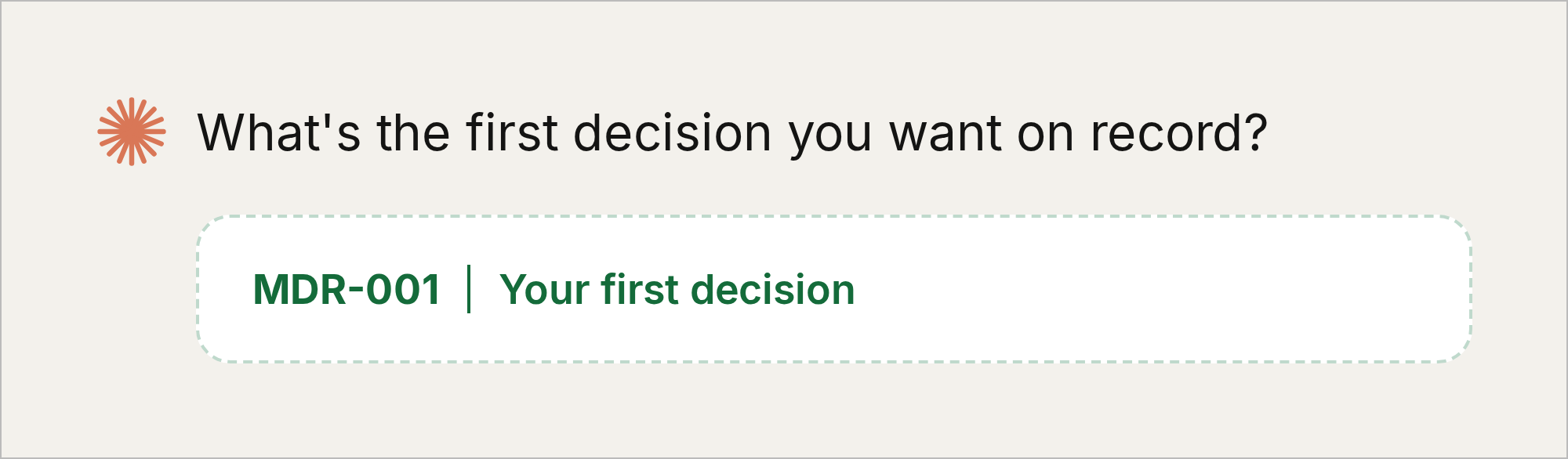
Memolok is in early testing, and we're inviting people to try it now. Sign up today and start recording your decisions. A person reads that list, so nothing lands in your inbox automatically.
Common questions
Isn't this just business intelligence?
Business intelligence, the Decision Support pillar above, hands you dashboards and analytics about the world outside: the market, operations, your customers. It's data to help you decide well, going forward.
The Decision Record is a different kind of thing, not a better version of the same thing. It holds no data about the market. It holds the reasoning behind decisions your organization has already made: what was decided, what else was considered, what was known at the time, and what you expected to happen. A BI dashboard can tell you what's happening right now. Only a Decision Record can tell you why you responded to it the way you did, and whether that reasoning still holds.
The two aren't competing for the same budget line. A dashboard and a Decision Record answer different questions, and most organizations that need one need the other too.
Isn't this just a wiki with AI on top?
Pointing an AI assistant at your wiki gets you plausible prose, not an answer. Wikis, tickets, and shared drives hold contradictory edits, ambiguous status, and half-finished arguments; asked what you decided, an assistant reconstructs a story from those fragments, and it is at its most convincing exactly when it is guessing.
The gap is not storage, and it is not diligence: you can write beautifully and still have nowhere that says which decision is in force. A structured record answers a different class of question: what still stands, what replaced what, who was accountable, which premises have since turned out to be wrong. When a premise is corrected, that correction is recorded too, so the decisions resting on it can be found instead of depending on somebody remembering they exist.
Isn't this the same as a semantic layer or ontology?
A semantic layer or ontology defines what your terms mean: what "revenue" or "active user" refers to, so an agent stops guessing about vocabulary. That's forward-looking too, the same shape as the Decision Support pillar above, but aimed at meaning instead of data. It holds no record of what your organization chose, why, or what you expected to happen. A Decision Record and a semantic layer answer different questions, and most organizations that need one need the other too.
Doesn't my AI already remember this?
Model memory is built for one person's conversation, self-overwriting as new information arrives, with nothing that says whether a fact is still current or something a supersession chain has since replaced. A Decision Record is shared across a team, sealed once it's made, and structured enough to enumerate: what was decided, what else was considered, and what's still open. Better model memory makes the assistant more useful in the moment. It doesn't give your organization a queryable account of what it decided and why.
What to read next
- Decision debt: the compounding cost of decisions that were made, often carefully, and never recorded.
- Decision records for AI agents: why an agent starting every session cold needs the reasoning behind your decisions, not just their output.
- What you use today: how a Decision Record differs from an ADR, a decision log, or a page in Notion or Confluence.
- Context engineering: how the Decision Record differs from an ordinary note in an agent's context, sealed rather than overwritten.
- Glossary: quick definitions for the vocabulary used across this hub, MDR, MDL, Decision Automation, Decision Support, and more.