
How Memolok works
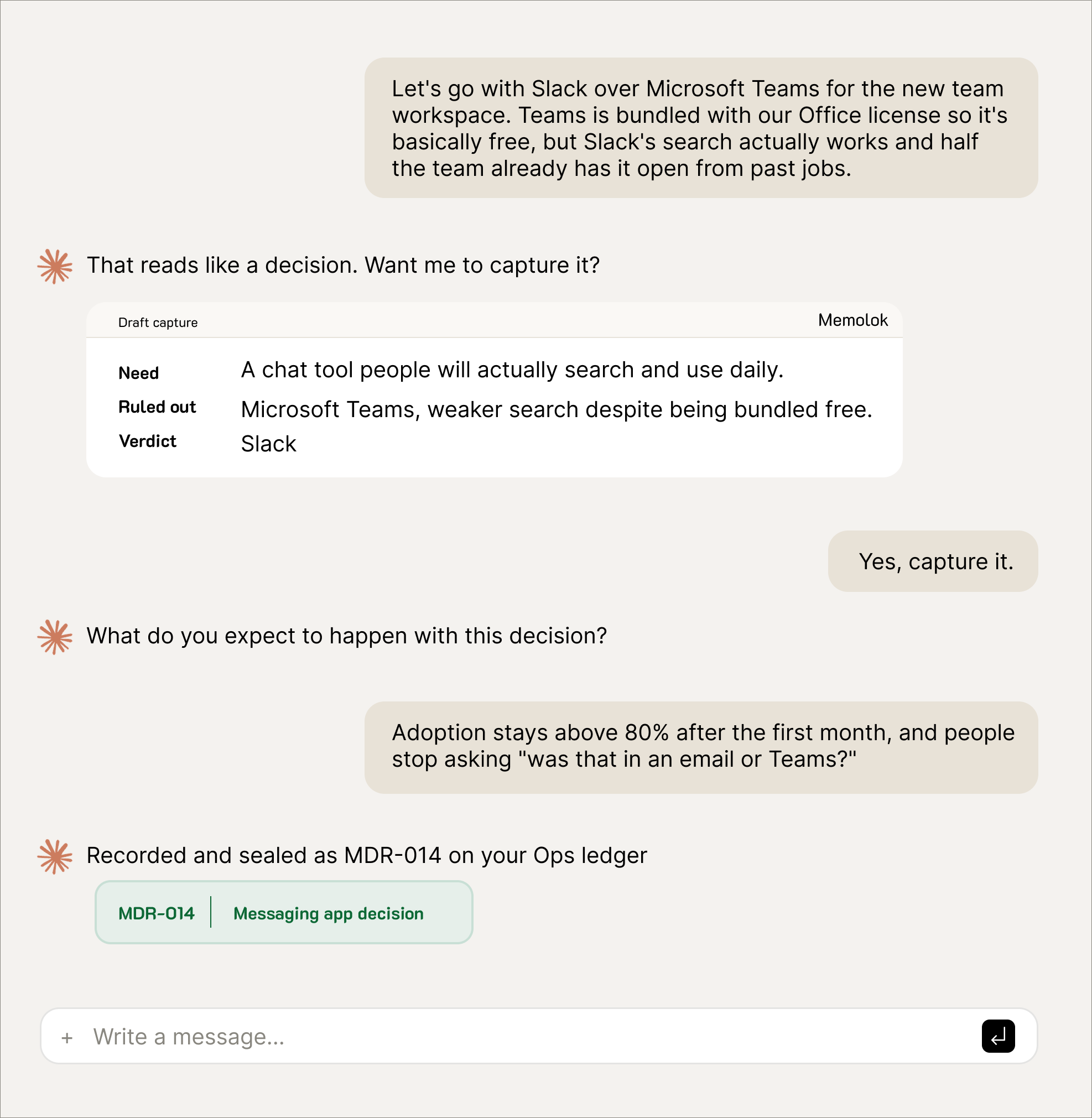
Memolok runs as a plugin for Claude Code, Claude chat, and Cowork, using the Model Context Protocol (MCP), so it shows up in the conversations you're already having. As you talk through a decision, Memolok notices the decision moment and flags it, like the example above. Agree, and it captures the decision: approve it on the spot, or adjust it and then approve. Once approved, it's sealed as a Memolok Decision Record, or MDR.
Ask it later, and it answers
The point of recording a decision is being able to ask about it after everyone's forgotten the details.
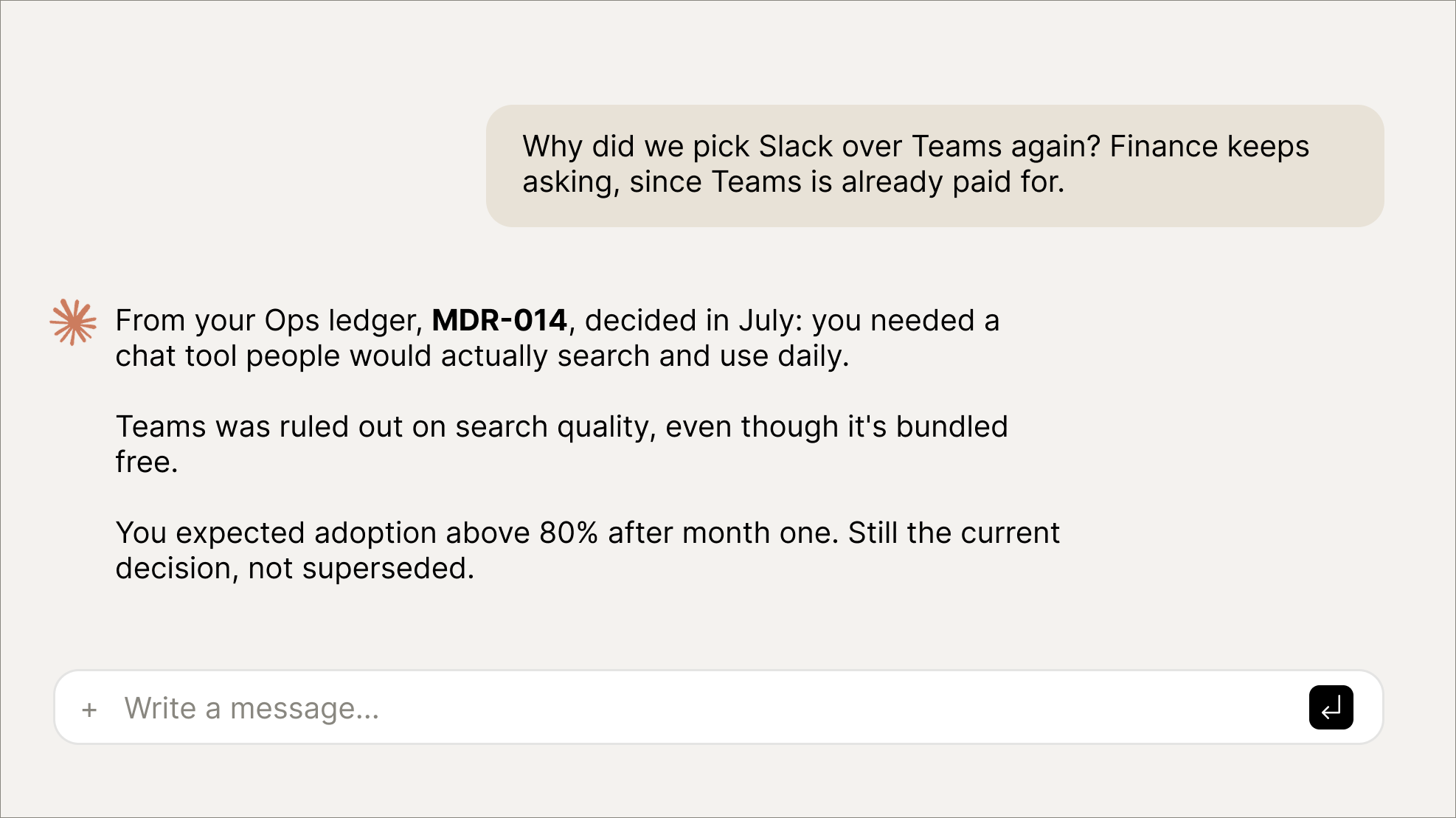
That answer came from the record itself, not from someone's memory of a meeting six months back. It carries its status too: whether this is still the decision in force, or whether it's been superseded since.
What's in a Memolok Decision Record

Every MDR has the same six parts:
| Element | What it captures |
|---|---|
| The need | What had to be true, stated sharply enough to be tested afterward, not "improve performance," but the specific bar the decision existed to clear. |
| The alternatives | Each option on the table, with the argument that ruled it out, so a rejected option doesn't return eighteen months later as a fresh idea. |
| Premises | Kept separately from the decisions that rest on them: a budget, a contract term, a regulation, a supplier with no real competitor. |
| Committed status | Distinguishes a decision still being deliberated from one that has been made. |
| Expected outcomes | Committed at the moment of the decision, assessable afterward against what happened. |
| Explicit deferrals | Recorded as first-class open questions rather than lost in prose. |
Every record also carries who decided: the chain of agency behind it, who raised it, who framed the need, who wrote it up, who committed, carried on the record itself rather than left to a git blame or someone's memory.
Memolok doesn't wait for a decision to be well argued
Memolok doesn't discriminate by how finished a decision looks. Even a matter you've only parked, with nothing decided yet, has a place on the ledger. Once you do decide, the record can be either:
- A "thin" MDR: one option, no real argument behind it, still sealed, still queryable.
- A "rich" MDR with the full picture: alternatives, premises, expected outcomes.
Both of them belong on the ledger, and sealing a record as Accepted or Rejected is a real commitment either way, closing the door on a rejected option coming back in a year with nobody remembering it already lost.
A decision doesn't need to be right, finished, or even fully argued to belong here. It needs to be real.
Approved decisions are frozen
Every MDR you approve lives in a Memolok Decision Ledger, or MDL, the record for one line of reasoning, whether that's one person, one team, or a whole organization, and you can keep as many MDLs as you need. Memolok compiles the MDRs in an MDL into a single, current account of how your decisions fit together, and that's what your AI agents query when they need your reasoning, not the raw records one at a time.
Approved decisions are frozen. Later thinking does not quietly rewrite a record: it supersedes it, and both stay on the ledger, each honest about the moment it was made. Supersession chains turn "is this still the decision?" into a question with an answer rather than a search. See the glossary for quick-reference definitions of MDR, MDL, and supersession.
What happens after: the wake
A decision doesn't end at commitment. Everything that happens afterward, whether it worked, is the wake, and Memolok tracks it separately from the decision itself.

What you expected is checked against what actually happened, and the gap between the two is a learning delta, worth noticing whether the decision beat expectations or missed them. If a premise a decision rested on turns out to be wrong, a budget that changed, a regulation that shifted, Memolok flags every decision standing on it as a polluted premise, so nobody has to remember to go check.
Try Memolok today
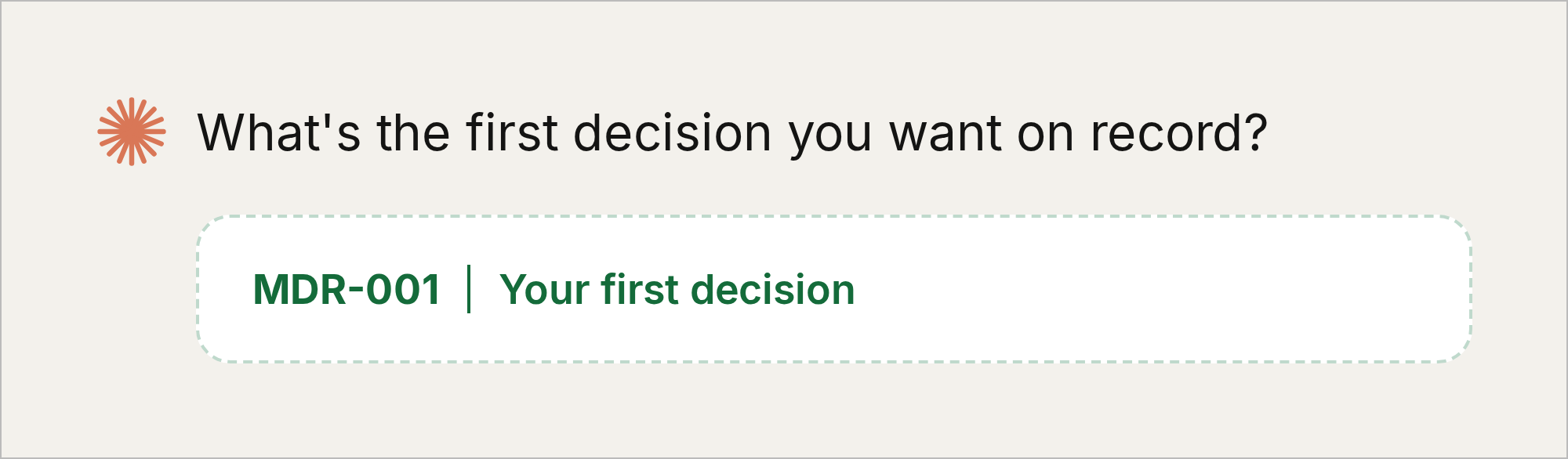
Memolok is in early testing, and we're inviting people to try it now. Sign up today and start recording your decisions. A person reads that list, so nothing lands in your inbox automatically.
See the Product page for why teams adopt Memolok, or the full comparison page for how this compares to what you use today.
Common questions
How do I track why a past decision was made?
Ask, in plain language, right where you already work. Memolok's plugin runs inside Claude Code, Claude chat, and Cowork, and answers from the structured record it captured at the time, not by searching documents that might mention the decision. If the decision predates Memolok, you can still capture it after the fact, walking through what you remember, and it becomes just as queryable from then on.
What is a Memolok Decision Record (MDR)?
A Memolok Decision Record, or MDR, is Memolok's structured, immutable record of a single decision: the need, the alternatives and what ruled them out, the premises it rested on, the commitment, the expected outcome, and what it deliberately left open.
What is a Memolok Decision Ledger (MDL)?
A Memolok Decision Ledger, or MDL, is the collection of MDRs for one line of reasoning: a person, a team, a project, or a whole organization. You can keep as many MDLs as you need, and each one compiles into a single, current account your AI agents can query.