
Getting Started With Memolok
You installed the plugin, connected your account, and Claude told you Memolok was ready. Now you are looking at a blank chat, wondering what you are actually supposed to type. This page is for that exact moment.
Good to Know
Feedback is how Memolok gets better
Memolok is still actively being shaped, and you are one of a small number of people actually using it right now. Telling us what felt clunky, confusing, or just plain wrong is the only way to help us get it right!
About your data
Everything you record is safe. We have no plans ever to erase it or sell it, and we back it up daily. That said, treat this as an early setup, not corporate-grade security. Only the people with access to a ledger can see it.
Decisions Live Here
You have certainly lost unsaved documents before, and that taught you to save often. Decisions deserve the same habit. Catching yourself re-arguing something you are fairly sure you already worked through is that unsaved document: a decision you never wrote down, rebuilt from memory, and worse for it.
Without a decision record:
- The choice stays, but the reasoning disappears. Weeks or months later, the honest answer to "why did I do it this way?" is, at best, a guess.
- Settled questions get reopened, because nothing on record says you already worked this through.
- Sound choices get second-guessed, because only the choice survives, not the situation.
Memolok is the habit of recording decisions; it's where decisions live.
Tell Claude what you decided and why, the way you would explain it to a friend: what you were trying to achieve, what else was on the table, why you went the way you did, and what you expected to happen. Once it is written down, you can't quietly edit it later to look wiser than it was. If your thinking changes, make a new entry that points back to the old one.
The payoff: weeks, months, or years later, when you, or an AI agent working on your behalf, need to know why something is the way it is, the answer is sitting there instead of having to be reconstructed from memory.
The shape of one Memolok Decision Record (MDR)

The Words You Will See
Memolok has its own vocabulary. You never have to use these words yourself: Claude does the translating.
| Term | What it means |
|---|---|
| Memolok Decision Ledger (MDL) | The notebook your records live in. One ledger per body of work: one for a project, one for a house renovation, one for something else entirely. Most people start with a single ledger and split later, once they notice they are really keeping two separate trains of thought in one place. |
| Memolok Decision Record (MDR) | One decision, written down whole: what you needed, what else you considered, what you chose, why, and what you expected to happen. An MDR belongs to exactly one MDL and cannot exist without one. |
| World facts, kept in the almanac | Things true regardless of any one decision: the budget is 10,000 euros, the deadline is the end of March. Decisions point at these rather than repeating them, so when a fact changes, every decision that leaned on it is easy to find. |
| Scratchpad | A disposable working notepad: a pasted quote, a rough number, a link. Freely edited and deleted, unlike an MDR, which is not. Not sure if something is a decision or a scratchpad? Ask yourself whether it would be bad if it quietly vanished. If yes, it belongs in a decision or a world fact instead. |
What a ledger holds
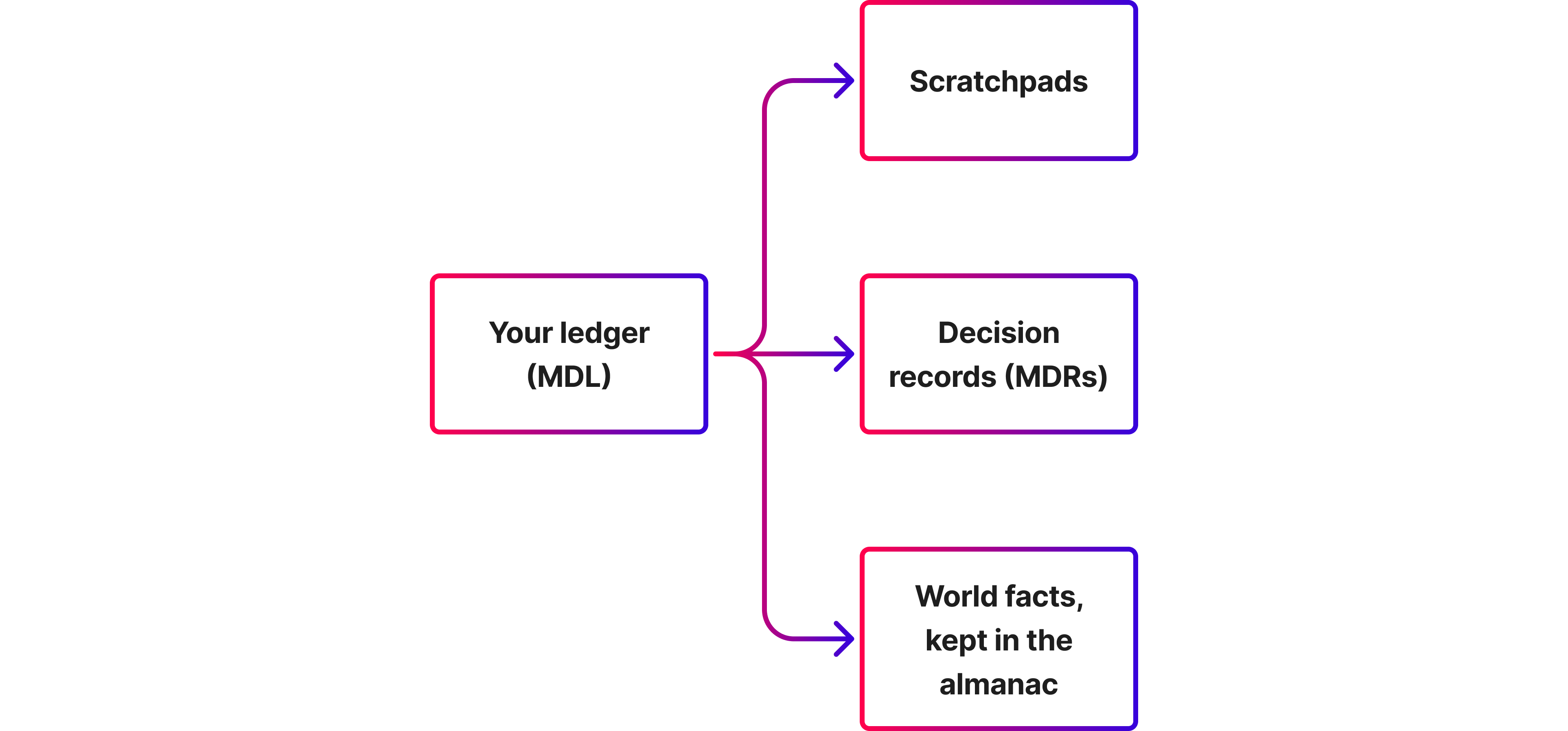
The ledger comes first, always: type /start to pick or create one before anything else.
Two more words come up constantly once you start, plus one that only shows up later:
- A matter is something you have noticed but not decided anything about yet, in your own words.
- A verdict is the choice inside an MDR: which option you went with, and why. You write it while you are still deliberating, and it freezes the moment you accept a decision.
- The wake is everything that happens after you commit, compared later against what you expected.
You don't need to remember any of that right now. Ask Claude to explain any of it at any time, ledger or no ledger, using /help.
After the verdict

A Good Setup for Your First Test Inside Claude
- Create a project first, before you type anything. Open Claude, look for Projects in the left sidebar, in Chat or in Cowork, and use the plus button to start a new one.
- Name it after the body of work, not after the fact that you are testing something. "Kitchen renovation" beats "Memolok test."
- Start a chat inside that project, and type
/start. It checks the connection, signs you in if needed, and helps you pick or create a ledger. If Claude answers normally instead, make sure you triggered the Memolok skill and not something else with the same name. - Click Allow the first time Claude asks permission to write. Expect an unfriendly-looking machine name like
create_MDRunderneath: that is Memolok talking to itself.
Two more shortcuts, though you will not need either one today:
| Type this | What happens |
|---|---|
/help |
Explains anything about Memolok in plain language. |
/grill-me |
A guided interview for a decision you have not fully worked out yet. |
You do not actually need the shortcuts
Memolok is built to notice a decision inside an ordinary conversation and offer to record it. Describing your decision in plain language works just as well as typing a command. If Claude ever seems to have ignored Memolok, say "use Memolok to record this."
Two Examples
One from software, one from well outside it, to show that the same decision shape works either way. That is a core principle of Memolok: it is built to be industry-agnostic.
Starting a Small Dev Project
The Backend Language Decision
- Need: something the one person building this already knew well, so three weeks would go into the product, not into learning a language.
- Alternatives: Python with Django, Ruby on Rails, Node with Express.
- Verdict: Node, because it was the option nobody had to look anything up for.
- Expected outcome: the whole backend running within a day.
The Frontend Approach Decision
- Need: pages that update without a full reload, without adding a build pipeline for a three-week project.
- Alternatives: React, plain HTML with a sprinkle of JavaScript, htmx.
- Verdict: htmx, because it got the interactivity without a frontend framework to maintain.
- Expected outcome: the interactive bits working without ever touching a build step.
Two short records, one ledger, and six months from now, when someone asks why it is built this way, the answer is already written down instead of guessed at.
Renovating a Room
The Bathroom Decision
- Need: the bathroom usable again without a full renovation, on a budget that ruled out moving any plumbing.
- Alternatives: a full gut renovation, living with it as is, a targeted fix.
- Verdict: the targeted fix (reglaze the tub, replace the grout, add a heated towel rail), because it solved the actual complaints without the cost or the six weeks without a working bathroom.
- Expected outcome: a bathroom that feels new, done inside two weeks, for a fraction of a full renovation.
The Contractor Decision
- Need: someone who could start within a month and had done a reglazing job before, not just full renovations.
- Alternatives: three contractors.
- Verdict: the second one, despite a slightly higher quote, because it was the only one that could show finished reglazing work.
- Expected outcome: work starting on time and no surprises once it does.
Two records, one ledger, and if the tub starts looking rough again in two years, the ledger already has the answer on whether you've already looked at replacing it.
The Stages an MDR Moves Through
A record moves through a few statuses on its way to being sealed, and only one line really matters: the moment you commit.
Before you commit, you can rewrite anything:
- New. Just created, nothing worked out yet.
- Deliberating. The working state, where most of a decision's life is spent. A record can look finished here. Looking finished is not the same as being committed.
- Proposed. A candidate choice and a drafted verdict, waiting for someone to commit it.
At commitment, the record seals in one of two ways:
- Accepted. You commit to going with it, and it needs one more thing first: what you expect to happen as a result. The need, the alternatives, the verdict, the expected outcomes, the open questions, and who decided and who wrote it up are frozen from this moment.
- Rejected. Just as real a commitment as accepting.
After commitment, nothing gets patched. A sealed record stands as evidence of what you knew when you chose. Correcting it means a new record: one that amends it, replaces it outright (marking the old one Superseded), or, if nothing has leaned on it yet, withdraws it.
What to Try Next
- Pick whichever of the two shapes above is closer to what you actually have going on right now.
- Record one real decision, not an invented one.
- Describe it to Claude the way you would explain it to a friend, and let it ask you the rest.
Once You're Past the Basics
A handful of moves worth knowing once recording a decision feels routine.
- Reject on purpose. Say "I reject it" whenever that is the honest outcome. It stops the same question from resurfacing next month.
- Revise a decision that turned out wrong. Say "I want to revise that decision." Nothing depends on it yet: back to draft. Something does: a new record supersedes it.
- Leave something open, honestly. Memolok records it as an open question that travels with the record, and a later decision can come back and settle it.
- Start from a matter. Say "Something keeps bugging me: [whatever it is]. Help me work out what the actual problem is." It is fine for this to end in no decision at all.
- Ask your ledger questions. "What's on my ledger?", "What am I still deliberating?", "What did I decide about [X], and why?"
- Close the loop. Tell Claude what actually happened: "Here's what happened with [X]." When it disagrees with what you expected, that gap is often exactly where your next decision starts.
Signs a Record Is Going Wrong
- A need that runs to a paragraph is more than one decision. Split it.
- Listing only one option when others were on the table leaves out what was actually weighed. A decision with a single option is still welcome on the ledger.
- Two verdicts in one record means two decisions got folded together. Split them.
- No expected outcome means there is nothing to check the decision against later.
- Rewriting expectations to match what happened is the worst: it leaves a ledger where nothing can be learned from anything.
If something does not behave the way this page describes, let us know on the contact page.